
How to Display Art Prints Without Frames: 7 Stylish Ways
Table of Contents
- Why Go Frame-Free? Aesthetic, Cost, and Rental Benefits
- The Best Adhesive for Hanging Art Prints (and What to Avoid)
- How to Hang Art with Binder Clips for an Industrial Look
- Using Wooden Poster Rails for Prints: A Clean, Modern Option
- Washi Tape, Photo Ledges, and Magnetic Strips: More Frame-Free Ideas
- Archival Safety and Weight-Bearing Limits: What Not to Do
- Rental-Friendly Removal: How to Take Down Displays Without Wall Damage
- Conclusion
- Frequently Asked Questions
Last Updated: September 20, 2026
Why Go Frame-Free? Aesthetic, Cost, and Rental Benefits
Learning how to display art prints without frames is faster, cheaper, and more flexible. Framing adds cost, weight, and a trip to a shop; going frame-free skips all three.
Here is why so many people skip the frame:
- Lower cost. No custom frame, no mat board, no glass.
- Less weight. Paper is light, so hanging is simpler.
- Renter-friendly. Most methods come down without leaving holes.
- Flexible styling. You can swap prints with the season.
The Best Adhesive for Hanging Art Prints (and What to Avoid)
The best adhesive for hanging art prints is a removable adhesive strip rated for the weight of your print. Mounting putty works for very light paper; permanent tape and glue are the wrong tools. Weight decides everything: a light print on smooth paint can hang on a strip, while a heavy or oversized print needs a mechanical hold, like clips or a rail.
Damage-Free Command Strips and Mounting Putty
Removable adhesive strips are the workhorse of frame-free hanging: they hold a surprising amount for their size and pull free when you are done.
- Use strips for: light prints, smooth painted walls, short-term display.
- Use putty for: corners of small prints, posters, and lightweight paper.
- Skip both for: textured walls, fresh paint, and anything heavy.
Adhesive Risks: Residue, Paint Peeling, and Paper Damage
Adhesive is not risk-free. The 3M Command brand guidance on damage-free hanging explains that strips work best on smooth, clean, painted surfaces and can pull paint if the wall was freshly coated.
Two more risks matter for the art itself:
- Residue. Cheap tape leaves sticky patches that attract dust.
- Paper damage. Tape applied directly to a print can lift the ink or tear the paper fibers when removed.
How to Hang Art with Binder Clips for an Industrial Look
Binder clips turn a plain print into a deliberate design choice. The metal clip becomes part of the look, and the paper hangs loose and casual.
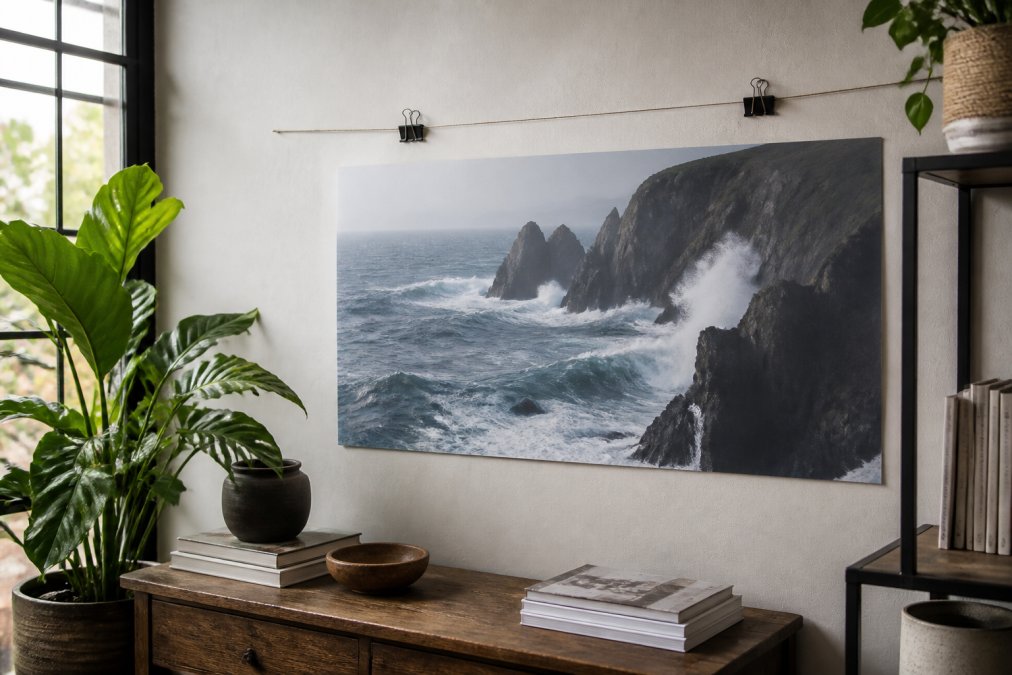
Step-by-Step: Clip, String, and Nail-Free Setup
Total time: 15 minutes Difficulty: Beginner
What you'll need:
- Binder clips (two per print)
- Twine, string, or thin wire
- Two small removable hooks
- A level or a phone level app
- Clip the top edge. Slide a binder clip onto each top corner of the print.
- Tie the string. Run twine between the two clips, leaving a little slack.
- Set the hooks. Place two removable hooks on the wall, spaced wider than the print.
- Hang the string. Loop the twine over both hooks.
- Level it. Nudge the clips until the print sits straight.
Expected result: A clean, industrial look with zero wall damage.
Using Wooden Poster Rails for Prints: A Clean, Modern Option
Wooden poster rails give the most polished frame-free result: two slim bars, top and bottom, hold the print flat and straight. The top rail hangs on the wall and the bottom rail adds weight, so the result looks intentional, not improvised.
Weight Limits and Installation Tips for Rails
Rails hold more than adhesive but still have limits: a long rail with a heavy print needs proper anchors, not just a hook.
- Check the rail's rating before you buy.
- Use wall anchors for anything larger than a standard poster.
- Match the rail width to the print width, or go slightly wider.
- Leave a small gap at the bottom so the paper can breathe.
Washi Tape, Photo Ledges, and Magnetic Strips: More Frame-Free Ideas
Three more methods cover almost every wall and style, each with a real weight ceiling to know before you commit a print.
Washi Tape: Light Paper Only
Washi tape is a low-tack paper tape that holds by surface contact, not chemical grip, so it releases cleanly from painted drywall and most wallpapers. The trade-off is holding power: it suits lightweight sheets, roughly a letter-size print on thin matte paper, while heavier cardstock or a stiff poster will slowly peel the tape off the wall.
- Best for: lightweight prints, quick swaps, dorm and apartment walls.
- Apply it: tape the top two corners only, folding a small tab under each end so you have something to grab at removal.
- Style fit: Minimalist and Scandinavian walls. Choose a tape color that matches the wall for an invisible hold, or a contrasting color to make the tape part of the design.
- Avoid: textured walls, fresh paint (cured less than a few weeks), and humid rooms.
Photo Ledges: The Rotation Method
A photo ledge is a shallow shelf, typically 2 to 3 inches deep, mounted to the wall. Prints lean back and rest on it, and no adhesive touches the paper, making this the safest frame-free method for the art itself.
- Best for: rotating a collection, mixing sizes, layering a large print behind a smaller one.
- Mechanism: the ledge carries the weight; the wall anchors carry the ledge. Use anchors rated for the shelf plus the prints.
- Style fit: Bohemian and transitional walls. Group odd numbers, vary heights, and let one print overlap the next.
- Watch for: dust on the exposed top edge, and prints sliding forward if the ledge is not level.
Magnetic Strips: The Hidden Hold
A magnetic display system uses a steel strip or channel mounted to the wall plus a thin magnetic strip or pair of magnets that pinches the paper against it, so the print appears to float with no visible hardware.
- Best for: clean, gallery-style walls where you want zero visible clips.
- Mechanism: the magnet clamps the paper against the steel; the steel carries the load. Check the maker's weight rating, since magnetic hold drops fast as print size grows.
- Style fit: Modern and Minimalist. Keep spacing even and stick to one print size per row.
- Avoid: very heavy or oversized prints, which can slip out of the magnetic grip over time.
Clipboards: The Casual Wall
A clipboard is a ready-made frame. Clip the print to the board and hang the board itself on a nail, hook, or adhesive strip. The board, not the paper, takes the hardware.
- Best for: casual, office, and kids' room walls.
- Style fit: Industrial and study-style walls. A grid of clipboards in matching sizes reads as intentional; mixed sizes read as collected.
Match the Method to the Style
Rather than picking a method at random, pick the one that fits the room:
- Industrial: binder clips on twine, clipboards, exposed metal rails.
- Minimalist: magnetic strips, washi tape in a wall-matching color, slim wooden rails.
- Bohemian: photo ledges with layered prints, washi tape in warm patterns, mixed sizes.
- Transitional: wooden poster rails top and bottom, or a single large print on a ledge.
Archival Safety and Weight-Bearing Limits: What Not to Do
Most frame-free guides stop at aesthetics and skip what actually shortens a print's life: light, moisture, and contact. Control those three and an unframed print can outlast a cheaply framed one.
The Three Enemies of an Unframed Print
Light. Ultraviolet and visible light fade pigments and dyes. The Library of Congress guidance on caring for works on paper recommends keeping works on paper out of direct sunlight and away from sustained bright light. A south-facing wall that gets hours of direct sun will fade a print noticeably faster than an interior hallway wall.
How Each Frame-Free Method Affects the Paper
- Adhesive strips and putty: the adhesive sits on the wall side, so the print face stays clean. The risk is at removal, when a strip can lift a thin layer of paper or ink if pulled too fast.
- Binder clips and clipboards: the clip pinches the paper edge. Over months, that pressure can leave a crease or a slight indentation. Slip a strip of acid-free cardstock between the clip and the paper to spread the load.
- Washi tape: low-tack and generally safe on the paper surface, but the tape's adhesive can leave a faint residue line if left in place for a long time.
- Magnetic strips: the magnet pinches the paper, similar to a clip. The pinch point is small, so keep magnets away from the printed area and clamp only the margin.
- Photo ledges and rails: the safest options for the art itself, because nothing adheres to or pinches the printed surface. The rail clamps the top and bottom margins; the ledge simply supports the paper.
Acid Migration: The Slow Damage
Ordinary cardboard, kraft paper, and some foam boards are acidic. When a print sits against them for months, acid migrates into the paper, causing yellowing and brittleness, most relevant for storage, but also for any backing board you lean a print against on a ledge.
- Use acid-free backing, mat board, or tissue for anything stored or backed.
- Store prints flat, not rolled, between acid-free sheets.
- Do not store against cardboard or in a hot attic or garage.
Weight-Bearing Limits by Method
Weight decides which method is safe. These are practical ceilings, not manufacturer specs, so always check the rating on the product you buy:
- Mounting putty: very light paper only, small prints.
- Washi tape: lightweight matte paper, small to medium prints.
- Removable adhesive strips: light to medium prints on smooth, cured paint.
- Binder clips on twine: light to medium prints, since the string and hooks carry the load.
- Magnetic strips: light to medium prints; hold drops as size grows.
- Wooden poster rails: the highest frame-free ceiling, and the only method that reliably keeps an oversized print flat.
A Quick Preservation Checklist
- Keep prints out of direct sun and sustained bright light.
- Avoid damp walls, bathrooms, and basements.
- Never tape or adhere anything to the printed face.
- Pad clip and magnet contact points with acid-free cardstock.
- Use acid-free backing and storage materials.
- Rotate prints in high-light spots every few months.
Rental-Friendly Removal: How to Take Down Displays Without Wall Damage
Removing a display is where most people cause damage, so pull slowly and at the right angle. Follow the maker's removal steps: for removable strips, stretch the tab straight down, not out, since pulling outward is what rips paint.
A simple removal checklist:
- Support the print with one hand before releasing the hold.
- Stretch adhesive tabs straight down, slowly.
- Peel washi tape back at a low angle, close to the wall.
- Wipe away any residue with a soft, damp cloth.
- Patch nothing if the wall is clean. Most removable methods leave no mark.
Conclusion
The hardest part of going frame-free is not the hanging but trusting that a bare print can look finished. It can, and the methods above prove it.
Frequently Asked Questions
How can I hang art prints without frames?
You can display art prints without frames using binder clips, wooden poster rails, washi tape, photo ledges, or adhesive strips. For a renter-friendly option, try damage-free Command strips or mounting putty. If you want a polished look, wooden poster rails hold prints flat and are easy to install. Always check the weight limit of your chosen method and avoid direct sunlight to prevent fading.
What to use instead of a picture frame?
Instead of a frame, try binder clips on a string, magnetic strips, wooden poster rails, or a photo ledge shelf. Washi tape works for lightweight prints, and adhesive mounting putty can hold small works on paper. Each method has different weight limits, so test with a small print first to avoid wall damage.
How do you hang art without damaging walls?
Use damage-free adhesive strips, mounting putty, or removable hooks designed for rental spaces. Command strips are popular for lightweight prints, but always follow removal instructions to avoid paint peeling. For heavier pieces, wooden poster rails or photo ledges distribute weight and require only small nails. Washi tape leaves little residue but may not hold long-term.
Can you use washi tape to hang art prints?
Yes, washi tape can hang lightweight art prints, especially unframed works on paper. It leaves minimal residue and comes in many colors. However, washi tape may lose stickiness over time, so it's best for temporary display or small prints.